Now that my agent (I love saying that) has my manuscripts, I'm no longer submitting. So, I decided to take a look back at my records from years past. My five easy readers with Continental Press came out between 1998 and 2003. I submitted a few things in the years after, but didn't get serious until 2011. All of the sales were to magazines.
2011--37 submissions, 5 sales
2012--50 submissions, 12 sales
2013--86 submissions, 4 sales and one contest win
2014--51 submissions, 2 sales
2015--82 submissions, 1 sale
2016--54 submissions, 2 sales
2017--44 submissions, 0 sales
2018--25 submissions, 0 sales BUT--Signed with my agent!
So, to total things up, in 8 years I submitted 429 times and sold 26 magazine articles! Here's hoping my agent can help my stories become traditional, hard-cover, beautifully illustrated picture books!
Sunday, May 13, 2018

Saturday, May 5, 2018
I am tickled pink--and blue!
Wow! What an incredible week! Sunday I walked past a corner in town that always reminds me of my writer friend and fellow cancer warrior, Maureen. It was here we had our photo snapped after we struggled to finish the Strawberry Days 5K a few years ago.

Maureen passed last fall, not long after she completed a triathlon at the age of 71! On this Sunday, the memory that came back so strongly was of her reading a rhyming story of mine out loud at a poetry group meeting. Her voice was so strong and expressive! She loved the story and encouraged me (she could be pretty bossy!) to keep sending it out. I did, and collected a few rejections, and decided to put it aside. But passing that corner and remembering Maureen, I thought, "Maybe I should send it out one more time..."
I looked on Manuscript Wish List for an agent and found one that looked like a possible match. I sent the submission to her on Sunday evening. I didn't check e-mail again until Monday, but the agent had responded within minutes! She loved the story, and wondered if I had other manuscripts. We e-mailed back and forth, and I liked her right away.
She called me on Tuesday and we chatted for a long time. She offered me representation and within hours we'd both signed the contract! A few more back and forth edits, and on Monday, she plans to send my story out to publishing houses!
I smile to think of my main character bopping through New York City. And I have to wonder if Maureen had a stern chat with the writing gods!
It's odd how the writer's journey can move as slowly as geologic time, and then, WHAM! One week changes everything. I realize that after a sale, stalagtites and stalagmites can grow again while I wait for the book to become a reality. (Well, at least two years.) But for now my head is in the clouds and I am tickled all the colors of the rainbow to be represented by Naomi Davis of BookEnds Literary Agency!

Maureen passed last fall, not long after she completed a triathlon at the age of 71! On this Sunday, the memory that came back so strongly was of her reading a rhyming story of mine out loud at a poetry group meeting. Her voice was so strong and expressive! She loved the story and encouraged me (she could be pretty bossy!) to keep sending it out. I did, and collected a few rejections, and decided to put it aside. But passing that corner and remembering Maureen, I thought, "Maybe I should send it out one more time..."
I looked on Manuscript Wish List for an agent and found one that looked like a possible match. I sent the submission to her on Sunday evening. I didn't check e-mail again until Monday, but the agent had responded within minutes! She loved the story, and wondered if I had other manuscripts. We e-mailed back and forth, and I liked her right away.
She called me on Tuesday and we chatted for a long time. She offered me representation and within hours we'd both signed the contract! A few more back and forth edits, and on Monday, she plans to send my story out to publishing houses!
I smile to think of my main character bopping through New York City. And I have to wonder if Maureen had a stern chat with the writing gods!
It's odd how the writer's journey can move as slowly as geologic time, and then, WHAM! One week changes everything. I realize that after a sale, stalagtites and stalagmites can grow again while I wait for the book to become a reality. (Well, at least two years.) But for now my head is in the clouds and I am tickled all the colors of the rainbow to be represented by Naomi Davis of BookEnds Literary Agency!
Monday, April 30, 2018
Trying to stay calm...
...but an agent is interested in my picture book called CONFETTI THE YETI! I AM SO EXCITED!!!
Sunday, April 29, 2018
My Interview With Kathy Doherty on her first book!
I met Kathy in 2011 when we attended the Highlights event in Chautauqua, New York, and we've been friends ever since. We went to two more workshops together at the Highlights' barn in Pennsylvania, and she sent me cards and gifts all through my cancer treatment in 2014. In the picture below, she's on the left and I'm the bald woman in the hat! She has a wonderful heart and great sense of humor, and I couldn't be happier for her with her first published picture book, DON'T FEED THE BEAR!

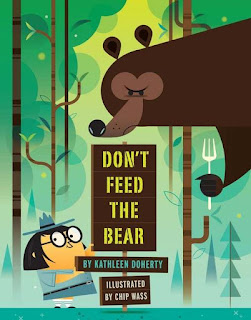
Hi, Kathy! Congratulations on your book coming out in April, DON'T FEED THE BEAR! You are an inspiration to those of us in our 50s and 60s who wonder if we still have a chance to be published. Can you tell us about your writing experiences that led up to this book? When did you start writing and submitting picture books?
I started by writing poems, short stories, and rebuses for Highlights. I've been published a total of 20 times in their magazines. But my first Highlights sale of six poems was never published. After that first sale, I got 10 rejections in a row. I didn't give up. Being in Highlights gave me confidence to try my hand at picture books. I like the tight writing that picture books require. I started submitting picture books through an agent in 2012. But she wasn't a hungry agent.
Can you tell us how you found an agent? Did you use an agent for this book?
My writing coach introduced me to her agent, and the agent took me on. She had me sign a contract. In the three years we were together, she only submitted two manuscripts. We parted in 2014 but she told me I could continue to show her manuscripts until I found a new agent. I showed her DON'T FEED THE BEAR, and told her it could be submitted to an agent at Sterling whom I had just met at an SCBWI conference. My ex-agent said the story was cute, but she didn't think it would sell. I submitted it to him and he bought it two months later. I was not under the agent's contract, so the sale was all MINE! I hired a literary property lawyer to negotiate the sale.
Have you worked closely with the illustrator? Did the editor ask for many changes?
I have had NO say in the illustrator's work. I've never even talked to him [Chip Wass] via email. Most of the time an editor will ask for a revision BEFORE he/she offers to buy the manuscript. I went through two revisions with Peachtree before they bought the story. [I don't have a publishing date for that book.] The Sterling editor bought the book without asking for any revisions. We put the finishing touches on the book in about four days.
Do you feel agents and editors are more open or less open to older writers, or does age matter to them?
This is a good question. If we are above average writers, age shouldn't matter. I'm finding agents want illustrator/author clients instead of just picture book authors. I've been rejected by 25 agents. So I've given up on that for awhile. I go through spurts.
Any tips for us as we continue to submit and hope?
Thanks so much for sharing your thoughts, Kathy! And I just know your book will be a great success! --Deb
My biggest tips would be to make sure your language is extra special. Those are the manuscripts that sell. I'm most often rejected because my word choice isn't stellar. So now I read my stories aloud, and sometimes tape record them and play them back to listen closely. I always make a dummy of 14 page spreads to see if I have 14 different scenes. Another tip is to leave room for the illustrator.
I wrote the following list for KidLit College's blog last year:
PICTURE BOOK WRITING TIPS for aspiring authors—
Rhythm
At first I’d get rejected because the language I used wasn’t special enough. So I read poetry and tons of picture books—still do—to study how authors put words together. Now I try harder to make my words dance across the page and let my personality shine through [voice].
Humor
When writing humor, I use words that contain these consonants: p, b, t, d, k, and hard g [as in goat]. Notice how these letters explode off your tongue and produce funny sounds. That’s why the word underpants is funnier than underwear.
Visualization
I make sure every sentence I write can be illustrated. I think of my story as an escalator, always moving and changing with each line. My words only tell half the story to leave room for the illustrator.
Intertextuality
I loved how Roahl Dahl used made-up words in THE BFG like whizzpoppers, frobscottle, and snozzcumbers. I borrowed that idea and made up words in the first two picture books I sold. Borrowing an idea or concept from another author and reworking it to make it your own is called intertextuality.
Stepping Stones
Rejection letters happen. Eileen Spinelli got 27 rejections on SOMEBODY LOVES YOU MR. HATCH. Jerry Spinelli never sold his first novel. Rejection letters are steppingstones to something bigger and better. After my first sale to Highlights in 2006, the magazine’s submissions editor sent me 10 rejection letters in a row before she bought a second story.
Professionalism
I use personalized stationery with my name, address, phone number, and email printed at the top so I can submit professional-looking cover letters. I paper clip my cover letter [short and succinct] to my story. I never fold or staple my submission.
Revision
When I think my manuscript is ready to submit, I tape record it. Then I play it back over and over listening for rough and boring spots. Then it’s revision time!
Page Turns
I make a dummy and read my story aloud. I emphasize the page turns as I read. I ask myself: Do I have 14 different scenes? Will readers care about my main character? Did I rush the beginning? Is my ending satisfying?
Craft
I’m always looking for feedback and ways to take my writing to the next level. I attend SCBWI conferences, take workshops, and belong to a critique group. I read books on craft. And I type out my favorite picture books to study them.
Perseverance
Perseverance is probably more important than talent. I’m living proof. Writing doesn’t come easy for me. Most writers let a rough draft flow off their fingertips. Not me. I agonize over every word and revise as I write. Every author is different. Candace Fleming writes in longhand before she gets out of bed in the morning. Beverly Cleary never reads other children’s books because she doesn’t want them to influence her. Eve Bunting likes to know the last line of her picture book before she begins. And Jane Yolen writes to find out how her story will end.
Importance
We picture book writers are important people. Be proud! We start children on the wonderful path of reading. Visualize a dad reading your book to his daughter at bedtime, or a grandmother buying your book for her grandson’s birthday. My dream has always been to read my picture book aloud to the children at St. Jude’s Children’s Research Hospital. I’M GETTING CLOSER!


Hi, Kathy! Congratulations on your book coming out in April, DON'T FEED THE BEAR! You are an inspiration to those of us in our 50s and 60s who wonder if we still have a chance to be published. Can you tell us about your writing experiences that led up to this book? When did you start writing and submitting picture books?
I started by writing poems, short stories, and rebuses for Highlights. I've been published a total of 20 times in their magazines. But my first Highlights sale of six poems was never published. After that first sale, I got 10 rejections in a row. I didn't give up. Being in Highlights gave me confidence to try my hand at picture books. I like the tight writing that picture books require. I started submitting picture books through an agent in 2012. But she wasn't a hungry agent.
Can you tell us how you found an agent? Did you use an agent for this book?
My writing coach introduced me to her agent, and the agent took me on. She had me sign a contract. In the three years we were together, she only submitted two manuscripts. We parted in 2014 but she told me I could continue to show her manuscripts until I found a new agent. I showed her DON'T FEED THE BEAR, and told her it could be submitted to an agent at Sterling whom I had just met at an SCBWI conference. My ex-agent said the story was cute, but she didn't think it would sell. I submitted it to him and he bought it two months later. I was not under the agent's contract, so the sale was all MINE! I hired a literary property lawyer to negotiate the sale.
Have you worked closely with the illustrator? Did the editor ask for many changes?
I have had NO say in the illustrator's work. I've never even talked to him [Chip Wass] via email. Most of the time an editor will ask for a revision BEFORE he/she offers to buy the manuscript. I went through two revisions with Peachtree before they bought the story. [I don't have a publishing date for that book.] The Sterling editor bought the book without asking for any revisions. We put the finishing touches on the book in about four days.
Do you feel agents and editors are more open or less open to older writers, or does age matter to them?
This is a good question. If we are above average writers, age shouldn't matter. I'm finding agents want illustrator/author clients instead of just picture book authors. I've been rejected by 25 agents. So I've given up on that for awhile. I go through spurts.
Any tips for us as we continue to submit and hope?
Thanks so much for sharing your thoughts, Kathy! And I just know your book will be a great success! --Deb
My biggest tips would be to make sure your language is extra special. Those are the manuscripts that sell. I'm most often rejected because my word choice isn't stellar. So now I read my stories aloud, and sometimes tape record them and play them back to listen closely. I always make a dummy of 14 page spreads to see if I have 14 different scenes. Another tip is to leave room for the illustrator.
I wrote the following list for KidLit College's blog last year:
PICTURE BOOK WRITING TIPS for aspiring authors—
Rhythm
At first I’d get rejected because the language I used wasn’t special enough. So I read poetry and tons of picture books—still do—to study how authors put words together. Now I try harder to make my words dance across the page and let my personality shine through [voice].
Humor
When writing humor, I use words that contain these consonants: p, b, t, d, k, and hard g [as in goat]. Notice how these letters explode off your tongue and produce funny sounds. That’s why the word underpants is funnier than underwear.
Visualization
I make sure every sentence I write can be illustrated. I think of my story as an escalator, always moving and changing with each line. My words only tell half the story to leave room for the illustrator.
Intertextuality
I loved how Roahl Dahl used made-up words in THE BFG like whizzpoppers, frobscottle, and snozzcumbers. I borrowed that idea and made up words in the first two picture books I sold. Borrowing an idea or concept from another author and reworking it to make it your own is called intertextuality.
Stepping Stones
Rejection letters happen. Eileen Spinelli got 27 rejections on SOMEBODY LOVES YOU MR. HATCH. Jerry Spinelli never sold his first novel. Rejection letters are steppingstones to something bigger and better. After my first sale to Highlights in 2006, the magazine’s submissions editor sent me 10 rejection letters in a row before she bought a second story.
Professionalism
I use personalized stationery with my name, address, phone number, and email printed at the top so I can submit professional-looking cover letters. I paper clip my cover letter [short and succinct] to my story. I never fold or staple my submission.
Revision
When I think my manuscript is ready to submit, I tape record it. Then I play it back over and over listening for rough and boring spots. Then it’s revision time!
Page Turns
I make a dummy and read my story aloud. I emphasize the page turns as I read. I ask myself: Do I have 14 different scenes? Will readers care about my main character? Did I rush the beginning? Is my ending satisfying?
Craft
I’m always looking for feedback and ways to take my writing to the next level. I attend SCBWI conferences, take workshops, and belong to a critique group. I read books on craft. And I type out my favorite picture books to study them.
Perseverance
Perseverance is probably more important than talent. I’m living proof. Writing doesn’t come easy for me. Most writers let a rough draft flow off their fingertips. Not me. I agonize over every word and revise as I write. Every author is different. Candace Fleming writes in longhand before she gets out of bed in the morning. Beverly Cleary never reads other children’s books because she doesn’t want them to influence her. Eve Bunting likes to know the last line of her picture book before she begins. And Jane Yolen writes to find out how her story will end.
Importance
We picture book writers are important people. Be proud! We start children on the wonderful path of reading. Visualize a dad reading your book to his daughter at bedtime, or a grandmother buying your book for her grandson’s birthday. My dream has always been to read my picture book aloud to the children at St. Jude’s Children’s Research Hospital. I’M GETTING CLOSER!
Sunday, November 19, 2017
My interview with rhyming author Matt Forrest Esenwine

Interview
with Matt Forrest Esenwine
- Congratulations
on the great reviews for Flashlight Night!
This is your first picture book, but have you had other rhyming
work published?
Thanks, Deb! Yes, I’ve had numerous poems published
over the years. My first was back when I was in high school – I sent a free
verse poem to the local college’s literary magazine and they liked it enough to
publish it! That set me on my path. Since then, several of my poems have been
published in literary journals and anthologies.
Up until 2009 or so, I was only publishing poetry geared for adults – primarily free verse – but I had some children’s poetry I’d written and didn’t know what to do with. A friend told me about SCBWI, I joined a local critique group, and began studying the craft as well as the market (a hugely important and often underestimated aspect of writing for children). My first children’s poem, “First Tooth,” was published in Lee Bennett Hopkins’ Lullaby & Kisses Sweet (Abrams Appleseed, 2015) and between that poem and all the others I have – or will have – published in books, online journals, and ‘Highlights’ magazine, the grand total comes to about 24! Granted, in publishing, the wheels turn slowly, but I’m extremely grateful I’ve been able to get this far so quickly.
Up until 2009 or so, I was only publishing poetry geared for adults – primarily free verse – but I had some children’s poetry I’d written and didn’t know what to do with. A friend told me about SCBWI, I joined a local critique group, and began studying the craft as well as the market (a hugely important and often underestimated aspect of writing for children). My first children’s poem, “First Tooth,” was published in Lee Bennett Hopkins’ Lullaby & Kisses Sweet (Abrams Appleseed, 2015) and between that poem and all the others I have – or will have – published in books, online journals, and ‘Highlights’ magazine, the grand total comes to about 24! Granted, in publishing, the wheels turn slowly, but I’m extremely grateful I’ve been able to get this far so quickly.
- Your voice
talent background taught you to pay attention to how written words sound
when read aloud. Was this helpful to you in writing picture books?
Yes, it was…but what was more important was my
ability to write radio copy (e.g., commercials). When writing a 30-second or
60-second radio commercial, one needs to create interest on some type of
emotional level; introduce a problem; offer a solution; and then conclude the
message. Sound familiar?? It’s a story! So no matter whether it’s a commercial,
a poem, a picture book, or a novel, the general structure is very often the
same – it’s how one varies that structure and what one does with it that makes
the difference.
- Which do
you find more challenging when writing, perfect rhyme or perfect meter?
Perfect rhyme, no question. Perfect meter can be
difficult, yes, but if one is writing in accentual verse rather than syllabic,
it’s the rhymes that are going to be front and center to the reader. As long as
the text flows, make sure those rhymes are as good as they can be.
- Rhyming
books are often a hard sell, partly because they’re tough to translate for
foreign markets. What would you say to encourage those of us who write in
rhyme?
I know of a number of folk who’ve written rhyming
picture books that have been translated into other languages, and they usually
end up as non-rhyming picture books. This is another reason why having a solid,
universal story – and text that can be appreciated even in prose –is so
important.
- Can you
share some creative marketing ideas you’ve used with Flashlight Night?
One of my first book signings was at night, and we
displayed the book on a projection screen so everyone could see. I talked about
the book a little bit, then showed the kids some shadow puppets on the screen,
and everyone left with a small flashlight of their own!
I also contacted a local hospital’s gift shop,
because I felt ‘Flashlight’ was the kind of quiet adventure book a young child
might enjoy while staying there. The manager loved the book and ordered a case,
and we scheduled a book signing during the “lunch hour” (a very loose term when
it comes to hospitals). Before the signing I visited the on-campus preschool
and read to three groups of young children, and by the time the signing rolled
around many of their parents were requesting copies! In fact, we sold out of
all the books in an hour - and I’m hoping to get back there before Christmas
for another go-round!
- What’s the
most fun you’ve had since your book came out?
I’ve really been enjoying the signings, actually.
Eventually when I’m old and grizzled (which may not be too long from now) and
have a wall of books to my name I’ll probably become haughty and
supercilious…but for now, I’m having fun meeting people and chatting with them
about the book, my contributions to various poetry collections, and children’s
publishing in general.
- What’s next
for you in your writing career?
Will your next book be in rhyme, too?
This spring, I’ll have my name associated with two
books! My second picture book, “Don’t Ask a Dinosaur” (Pow! Kids Books), which
I co-wrote with author Deb Bruss (“Book! Book! Book!”, “Big Box for Ben”), is
scheduled for a March release. It’s about a couple of kids trying to put on a
birthday party while their dinosaur friends – in the interest of helping –
destroy everything. It includes a short glossary at the end so readers can
learn more about the 14 different dinosaur species in the book…and yes, it’s
rhyming!
I also am extremely grateful to Lee Bennett Hopkins
for asking me to contribute a poem for his newest poetry anthology, “School
People” (Boys Mills Press), which is being published by the same folks who
published “Flashlight Night.” “School People is a collection of 15 poems about
all the grown-ups that kids meet when they go to school: teachers, principals,
the lunch crew, etc. Lee asked me to write a poem about the bus driver, so I’m
really looking forward to seeing all my fellow friends’ and writers’ poems!
Thanks, Matt! We’ll look forward to reading more of your
writing and rhyming!
Thank YOU, Deb – and
also thank you to Angie and everyone for including our little book in the Top
10!
Saturday, November 11, 2017
Seeing a Book as it Comes Into Being
In August I met with my writer friend Nancy Flood, and she shared pages and sketches from her newest book with me. As a writer, it is so exciting to watch a book take shape!
Nancy is having great success with her book Soldier Sister, Fly Home, a middle grade fiction set on the Navajo reservation. Nancy and her husband Bill lived in the Navajo nation for many years, and her book is authentic, funny, and touching. She has also been so very encouraging as I struggle with my Chipeta story.

Nancy is having great success with her book Soldier Sister, Fly Home, a middle grade fiction set on the Navajo reservation. Nancy and her husband Bill lived in the Navajo nation for many years, and her book is authentic, funny, and touching. She has also been so very encouraging as I struggle with my Chipeta story.

Friday, November 10, 2017
Ute Museum Opens, More Chipeta Beadwork!
On June 10th I drove to Montrose, CO for the opening of the remodeled Ute Museum. One of the translations of Chipeta's name is white singing bird, and I couldn't believe my eyes as a cloud shaped like a white feather stood above the museum! I was thrilled to finally see the shirt she beaded for her husband Ouray to wear to Washington, D.C.
It gave me the inspiration to continue trying to get her story told, in a book for young children.


It gave me the inspiration to continue trying to get her story told, in a book for young children.


Subscribe to:
Posts (Atom)